
Innovation
The Innovation programme expanded its role as the interface between the Movement, the academic world, and the emerging AI governance landscape.
Overview
Two strategic focus areas defined the first half of the year. The first is the work around AI, which moved from reflection and discovery into articulating a vision for the future. We developed a white paper with Open Future that frames Wikipedia and Wikimedia projects as critical public knowledge infrastructure in the age of generative AI—public goods worth investing in and protecting. We advanced these ideas at the AI-BRIDGES Symposium in London in May.
The next step is building a broader coalition through the “Road to Geneva” initiative, which aims to articulate a role for Wikimedia in the future knowledge ecosystem. We hope to enable a collective response from the Movement and like-minded organisations to ensure AI development strengthens— rather than extracts from— the knowledge commons.
Our second focus was deepening scientific partnerships. A cooperation agreement with Lib4RI (ETH Domain libraries) will deploy a Wikipedian in Residence using Sybilla — a gap-analysis pipeline developed with Sapienza University of Rome — to identify Wikipedia knowledge gaps drawn from the DORA repository and weighted by public demand. The model is designed to be replicable across the ETH Domain and beyond.
Internally, we have reorganised around the thematic areas of Knowledge Integrity & Preservation, Tech Community & Experimentation, Knowledge Quality & Structured Data, and Innovation Compass — each supported by external expert committees. This new structure allows us to draw on specialised expertise while keeping the internal team lean.
Key programme activities
© Alek Tarkowski (Open Future) & Ilario Valdelli (WMCH)
Released a white paper and summary document with Open Future on the future of Wikimedia projects in the AI era, proposing concrete steps on governance, sustainability, attribution, technical direction, and partnerships. We also received invitations to the Publicai and AI Bridges initiatives thanks to the work we’ve been doing on this topic.
© Wikimedia CH
Published the WikiCite white paper mapping future directions for Wikidata and structured bibliographic data in institutional workflows. We also began developing Wikibase training material for scientists and librarians in collaboration with the Wikidata team.
© Wikiklima
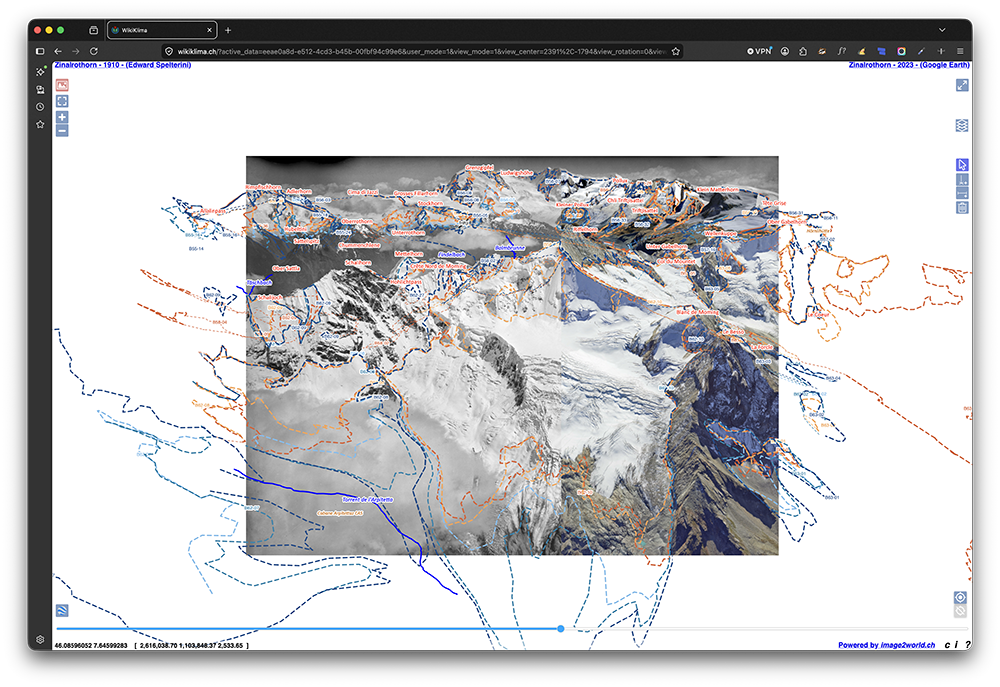
Advanced the Wikiklima/Wikiglaciers pilot, a hybrid platform pairing open Wikimedia content with validated scientific data on Swiss glacier retreat.
An early prototype co-registers the historical Spelterini photo archive with contemporary GLAMOS data and quantifies glacier mass loss.
Contributed to the AI-BRIDGES Symposium in London and advanced strategic conversations with partners from the Wikimedia movement, academia, civil society, and AI organisations. We are now preparing the “Road to Geneva” initiative, building a coalition ahead of the Geneva AI Summit 2027.
Launched the “Next 20” video series in January as a Jubilee initiative, inviting people to look forward to the next 20 years of Wikimedia CH.
Finalised a cooperation agreement with Lib4RI (ETH Domain libraries) to deploy a Wikipedian in Residence using Sybilla, our gap-analysis tool, to identify and fill Wikipedia knowledge gaps based on institutional repository content and public demand signals. The model is designed to be replicable across research institutions.
Signed a collaboration agreement with Science et Cité, strengthening cooperation in knowledge mediation and public science engagement.
Continued supporting innovation grants within the Wikimedia technical community, with several active grants focusing on AI-supported tools for contributors
Supported the Women in Data Science Conference in Geneva. Wikimedians Florence Devouard and Gilliane Kern shared their experiences as guest speakers.