


Experimentation & Innovation
The Innovation programme continued as a testing ground for experimentation and strategic foresight, particularly around societal and technological changes that impact Wikimedia projects.
© wikicite
Overview
In 2025, we focused on three priorities: advancing responsible AI integration, strengthening scientific partnerships, and building technical infrastructure. As AI systems increasingly mediate how people access knowledge, our work became more urgent. We positioned Wikimedia CH as a thought leader in debates about the future of collaborative knowledge systems.
A defining achievement was our strategic roundtable on Collective Intelligence vs Artificial Intelligence. We partnered with IMD Business School Lausanne and the Open Future Foundation to bring together 20 international experts, examining how generative AI is reshaping Wikimedia and the broader knowledge ecosystem. We also expanded academic partnerships across Swiss institutions, developed AI-powered tools addressing quality challenges on Wikimedia platforms and continued building the technical community and infrastructure essential for sustainable innovation.
Highlight activity
Collective Intelligence vs Artificial Intelligence: Strategic roundtable & white paper
© IMD
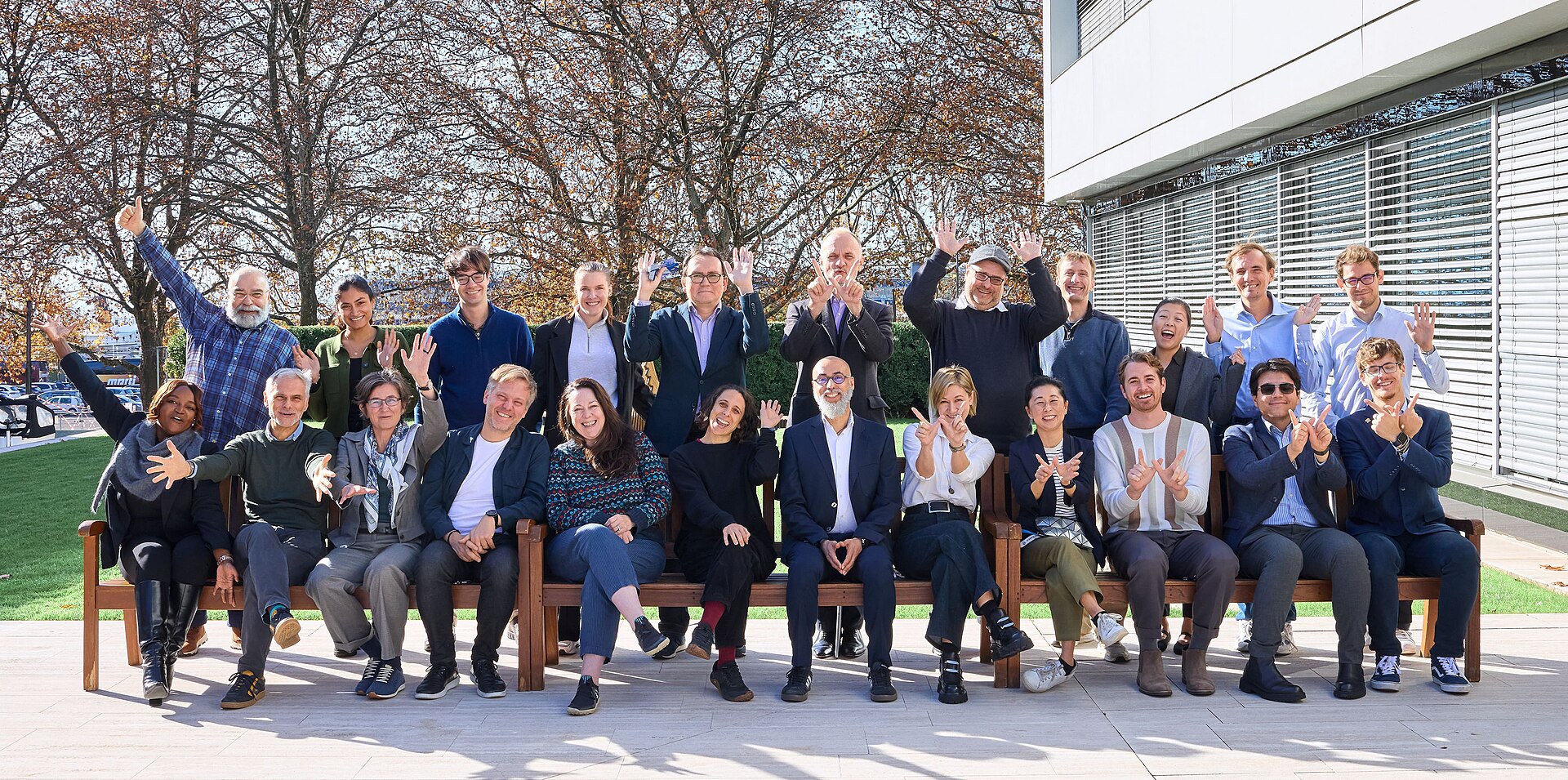
The Innovation programme reached a strategic milestone with the launch of a multi-stage initiative examining how generative AI is reshaping Wikimedia and the broader knowledge ecosystem. On 4 November, Wikimedia CH partnered with IMD Business School Lausanne and the Open Future Foundation to convene a strategic roundtable exploring the future relationship between human collective intelligence and artificial intelligence.
The roundtable brought together 20 experts from across the Wikimedia Movement, AI development, data science, journalism and research to address an urgent question: what happens to Wikimedia when AI stops merely reading Wikipedia and starts replacing it as a primary source of knowledge? Participants examined how a new “knowledge loop” is emerging where access to knowledge is increasingly mediated by AI tools, creating serious risks that knowledge commons like Wikipedia will be used for AI development without companies contributing back to them.
This initiative positions Wikimedia CH at the centre of global debates on AI, knowledge governance and the future of collaborative knowledge systems. The roundtable demonstrated strong external interest in Wikimedia’s role as a neutral, public-interest actor in the AI era, with partners expecting us to provide foresight beyond operational projects. Discussions highlighted the urgency for new governance models around AI transparency, open models and knowledge equity.
The insights will inform a white paper, interview series and actionable recommendations for the Wikimedia ecosystem in 2026, feeding directly into the Innovation Compass research line. The partnership with IMD and Open Future strengthened Wikimedia CH’s credibility across sectors and confirmed our ability to bridge research, policy and communities—though this requires stable investment in research-based innovation.
Key programme activities
Strengthened partnerships with Swiss academic institutions to make research more accessible and advance open science. This included:
- expanding the ResearCH goes Wiki project with new seminars at ETH Zurich;
- funding the Researchers in Wikidata project, which was presented at the Graduate Institute in Geneva;
- partnering with a University of Zurich research project funded by the Swiss National Science Foundation to investigate the influence and impact of generative AI on science communication in Switzerland;
- supporting the Open Science Retreat 2025; and
- co-organising a three-day seminar with ETH Zurich exploring the intersection of technology and society in history.
Advanced AI-powered quality improvement initiatives across Wikimedia projects, including:
- partnering with the IBM watsonx GenAI Challenge Switzerland 2025, where PhD teams from the Universities of Zurich and Lucerne developed prototypes identifying knowledge gaps in climate change coverage on Wikipedia;
- providing a grant for the Scaling Wikidata project to benchmark data quality challenges across languages and domains; and
- providing a grant for the CitationWatchlist project to help editors monitor and improve transparency and traceability of references in articles across Wikimedia projects.
© wikicite 2025
Co-hosted the WikiCite/Wikidata Conference in Bern along with Programme GLAM, bringing together libraries, researchers, and the future of structured data. This high-profile event strengthened Switzerland’s position as a hub for linked open data innovation.

© Kevin Payravi
Provided funding for WikiPortraits initiatives at major Swiss cultural events, including Eurovision and Art Basel. These initiatives enriched Wikimedia Commons with high-quality, freely licensed portraits while increasing the diversity and visibility of the artists on Wikimedia platforms. We also funded the development of Commons Gallery, a website where users can create galleries of WikiPortraits images.
© stats.wikimedia.swiss
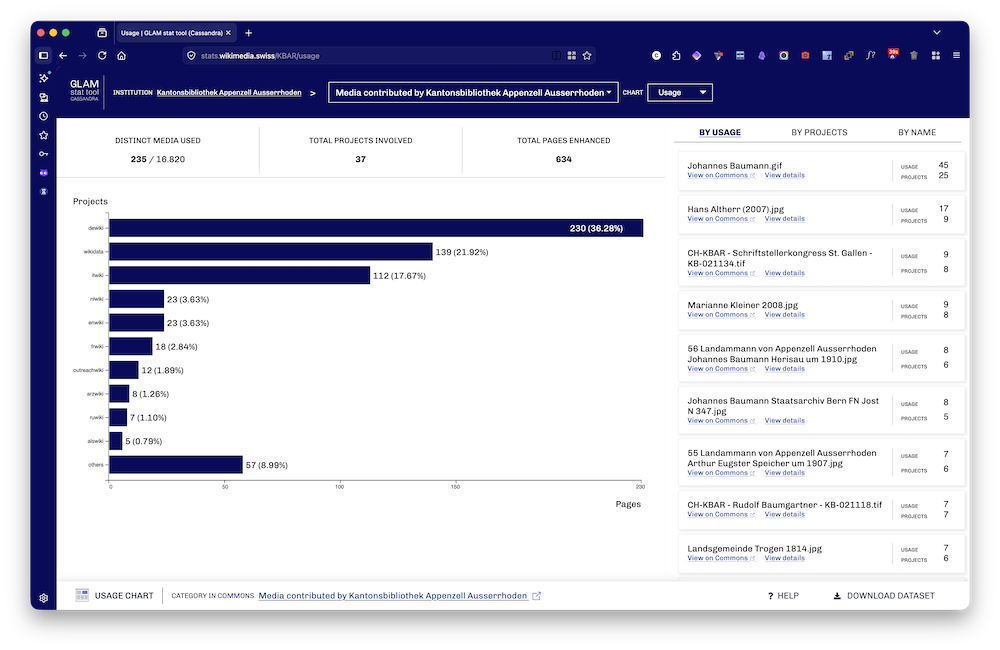
Released a new version of the GLAM statistical tool, which was re-engineered for better performance, reliability, and data visualisation capabilities.
Participated in the readout of 15 biographies of marginalised pioneers in Creative Computing, as part of an open call from the European Commission Research (COST-Action) group into Digital Grassroot Movements of Europe (GRADE). The initiative aims to establish best practices for publishing their OERs and data through Wikimedia Commons and Wikidata for the wider EC research community.
Upgraded Wikimini, the online encyclopaedia for kids, improving security, stability and performance.
Delivered educational workshops on AI and Wikimedia, including a talk on “AI-supported adaptive learning in Wikimedia projects” at the Open Education Day at the Bern University of Teacher Education. We also supported a workshop at the University Library of Zurich with Wikipedian Diego Hättenschwiler that provided insights into how GenAI models work and presented the Wikimedia Foundation’s strategy.
Launched the Dapples archive project to preserve, digitise and make the family’s heritage publicly available on Wikimedia Commons. This project led to interesting insights that will inform the Wikiklima project.
Took a leadership role at Jugend Hackt 2025 in the core organisational committee under Digitale Gesellschaft. Two editions in Zurich and Bern engaged 30 young people who developed 8 projects.
Programme impact
Key accomplishments
Positioned Wikimedia CH as a strategic voice in AI and knowledge governance, extending our influence beyond the Wikimedia Movement into academic, policy and corporate spheres.
Strengthened Switzerland’s reputation as a hub for open knowledge innovation by hosting the WikiCite/Wikidata Conference and helping research communities in major Swiss institutions engage with Wikimedia projects.
Developed AI-powered prototypes that directly address Wikimedia quality challenges, demonstrating how AI can support, not compete with, open knowledge projects.
Expanded free knowledge accessibility by upgrading educational platforms like Wikimini, enriching Commons with diverse portraits from major cultural events, and engaging 30 young people through Jugend Hackt to develop innovative projects.
Lessons learned
External partners increasingly see Wikimedia as a crucial neutral voice in shaping AI and knowledge systems, creating strategic influence opportunities beyond the Movement.
Partners expect insight and foresight, not just operational projects, confirming the need for the Innovation Compass to anticipate rather than react to future developments.
New governance models around AI transparency and knowledge equity are needed more urgently than anticipated, requiring Wikimedia to actively help define these frameworks.
Bridging research, policy and communities is a distinctive strength for Wikimedia CH, but requires stable long-term investment in research-based innovation.
Looking ahead
In 2026, the Innovation programme will focus on helping Wikimedia adapt to rapid technological change by developing responsible AI tools, monitoring emerging technologies, and building sustainability-focused projects. We will systematically analyse technological and social shifts to identify which developments will most impact Wikimedia projects, transforming potential challenges into opportunities for the global free knowledge movement. Building on the success of the 2025 roundtable, we will continue partnerships with high-level organisations like IMD and Open Future Foundation.
Key initiatives include launching the Wikiklima Observatory with two pilot projects integrating scientific and visual climate data into Wikimedia platforms, continuing Innovation AI expert roundtables, developing tools to improve Wikipedia quality, and establishing the Innovation Compass to produce strategic briefings on the future of AI.
We will support experimental projects through a new call for proposals, provide follow-up funding to projects incubated in 2025, and test AI-assisted translation tools. We will strengthen connections between open science and Wikimedia platforms and work to build a diverse technical community to ensure sustainable innovation within the Wikimedia ecosystem.